A Secular Need, COVID-19, and the Persistence of Anti-Muslim Sentiment in India
Share via
In Jeff Redding’s new book, A Secular Need: Islamic Law and State Governance in Contemporary India (University of Washington Press, Global South Asia series, 2020), the complex operations of a network of non-state Muslim courts and their diverse interactions with the state are explored. Typically, legal theorists center the state in their analysis, but A Secular Need argues that we need to focus more concertedly on non-state law, especially if we are to understand how power in the legal arena ultimately works. Moreover, without understanding the secular state’s dependencies on Islamic non-state legal actors in India, we will never fully appreciate why and how the Indian state remains so resolutely anti-Muslim. The state’s anti-Muslim politics have continued in the COVID-19 era, suggesting once again that there is stickiness to this politics whose underlying dynamics we ignore at our own peril.
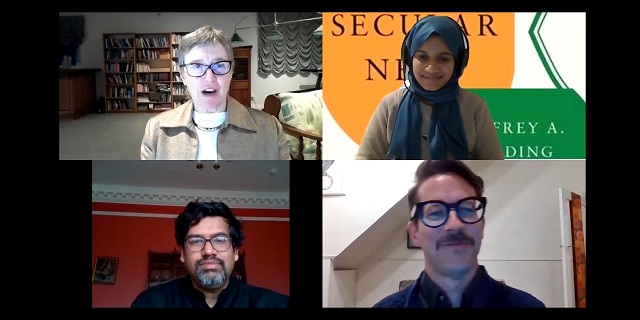
A recording of the panel discussion is available to watch here:
You can purchase a copy of the book here.
Panellists:
Dr Jeff Redding is a Senior Research Fellow at Melbourne Law School and a New Generation Network scholar at the University of Melbourne’s Australia India Institute. His research interests are in the areas of comparative law and religion, Islamic law, legal pluralism, family law, and law & sexuality.
Farrah Ahmed is a Professor at Melbourne Law School. Her research spans public law, legal theory and family law. Her recent work on constitutional conventions, constitutional statutes, religious freedom, the doctrine of legitimate expectations, the duty to give reasons, social rights adjudication and religious tribunals has been published in the Cambridge Law Journal, the Modern Law Review, the Oxford Journal of Legal Studies, the Law Quarterly Review, the International Journal of Constitutional Law, and Public Law.
Rohit De is Associate Professor of History at Yale University and Associate Research Fellow in Law at the Yale Law School. A legal historian of South Asia and the British Empire, he is the author of A People's Constitution: The Everyday Life of Law in the Indian Republic (2018). Supported by the SSRC and the Carnegie Fellowship, he is writing a book on the history of civil liberties lawyering and decolonization. Rohit has also written extensively on Islamic law and civil liberties in colonial India.