People, Place and Nature in Indigenous-Settler Relations
Recentring the More-than-Human World
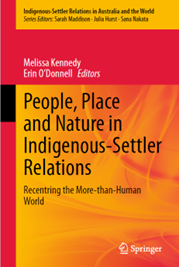
In a world that feels increasingly polarised and disconnected, this edited collection amplifies the voices of Indigenous People and settler allies from Australia, the USA, and Aotearoa New Zealand as we chart pathways to rebuild connection with each other and our more than human communities.
We are immensely proud that the authorship is majority Indigenous, and that there are multiple chapters featuring the work of Indigenous-Settler collaborations. This book includes established leaders as well as early career academics and practitioners, including recent University of Melbourne graduates from law and the Atlantic Fellows of Social Equity Masters program.
In Part 1, Words of the Land: Renaming, Resistance, and Renewal, we show how words—spoken, written, sung, or remembered—carry the potential to unsettle colonial narratives, rename spaces and histories, and renew responsibilities to Country.
In Part 2, Unmaking Extraction: Toward Restoration and Repair, we foreground Indigenous-led responses to the intertwined harms of colonisation and environmental degradation, asking what it means to resist extraction and actively regenerate relationships with land, water, whānau, and future generations.
In Part 3, Restoring Country, Restoring Justice: Pathways to Transformation, we showcase the enduring strength and resilience of First Nations peoples in their efforts to reclaim sovereignty, restore cultural practice, and transform colonial institutions. We demonstrate the centrality of land and water justice to restoration and repair.
We invite you to learn more about each chapter from each of the outstanding authors in the short videos below.
Chapter Contributions
Our contributors have made short videos introducing their chapters.
-
Melissa Kennedy and Erin O'Donnell
Chapter 1 - Introduction: Amplifying Connection, Care, and Decoloniality
-
Melissa Kennedy and Amy McCoy
Chapter 2 - Unsettling the Settler: Lessons in Belonging and Relationality by Listening to Country
-
Katrina Schlunke
Chapter 3 - How Does It All Come Back Now? Re-organising Naturalised Histories
-
Nola Turner-Jensen
Chapter 5 - Gender Responsibility Country: How Aboriginal People Define Their Role in Caring for the Universe
-
Anne Salmond and Manu Caddie
Chapter 6 - The Root of The Matter: Forests and Colonial Histories in Aotearoa New Zealand
-
Clint J. Hansen and Matthew J. Currell
Chapter 7 - Cultural Waters: Integrating Indigenous Knowledge and Governance for Justice and Sustainability in Central Queensland
-
Megan Thomas, Billie Lythberg, Dan Hikuroa and Gary Brierley
Chapter 8 - The River is an Island: (Re)imagining a More-than-human Future for the Waimatā Catchment
-
Jo Voice
Chapter 9 - Whānau Care: A Model for Equitable Support for kaitiaki whānau
-
Melissa Kennedy
Chapter 10 - First Nations Water Holder: The Future for Cultural Water in the Murray Darling Basin
-
Nina Roberts, Aunty Marilyne Nicholls, the Djaara Women’s Knowledge Group, Julie Andrews and Susan Lawrence
Chapter 11 - Walking Together: Djaara Women’s Journey to Restore Food Plants and Heal Country
-
Cormac Mercer
Chapter 12 - Securing Water Access: Economic Futures for Victoria’s Traditional Owners
-
Melissa Kennedy, Erin O'Donnell, Amy McCoy, Nicky Hudson and Ben Muir
Chapter 13 -First Peoples, Living Waters Cultural Exchange