‘As a first-generation migrant, this resonates deeply’
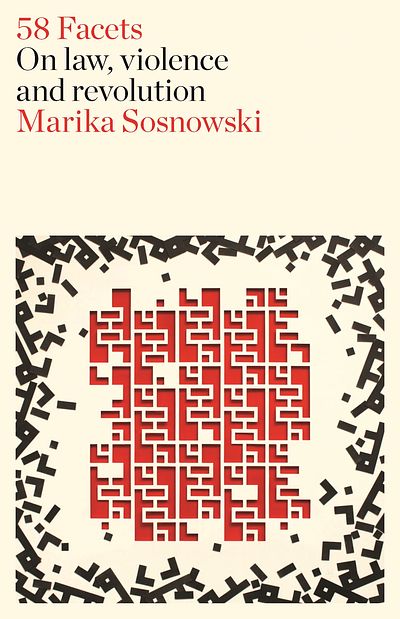
Associate Professor Radha Govil on the new book by Dr Marika Sosnowski, 58 Facets.
When I worked in a bookshop, it was important to shelve a book where you would expect the customer to find it. 58 Facets by Marika Sosnowski resists tidy shelving. Where, in the ritual of bookshop order, would I place it? Perhaps in politics or law…no, history… poetry?
Centred on conversations with Syrians in Syria and outside, Marika’s legal and anthropological scholarship, merges with stories of resistance, bravery, and fear, and her family’s own experiences of surviving and fleeing the Holocaust. The result is a small jewel of a book that offers reflections on a wide range of issues connected to the theme of the ‘legal afterlife’ of war and small ‘r’ revolutions. Here, her conversations with Syrians facing this afterlife are intentional and incidental at the same time. Is it journalism?
You get the sense that this is how Marika likes to conduct her scholarship: from the ground up. It's based on the people and their lived experience. Marika prefers the fragmental and the partial above the grand accepted narrative. She meshes the perspectives of witnesses, refugees, friends, and herself, showcasing an entwining of experience and legal fact.
She considers the mechanics of a checkpoint in Syria, but then a moment of personal anxiety at a checkpoint during the COVID-19 pandemic as she considers the role of checkpoints in her family history. It is an interplay between law, history, and psychology. The scholarship is slow, grounded in conversation and the person, rather than in just the statistics.
Amongst these vignette-like chapters is the author’s own familial narrative: the legacy of a grandfather who fled the Holocaust, and the deeds of her great-uncle Chaim Gaon, who was a significant player in the formation of the Israeli military, and whose directions against Palestinians Marika confronts candidly.
Yet despite its weighty subject, the book is accessible. Legal concepts appear conversationally, rather than by citation.
58 Facets is not written in a vacuum, away from the devastation in Gaza. Marika grapples with her direct family ties to the historical injustices perpetrated on the Palestinians, and the injustices continuing today. But she offers no neat resolutions in the conventional sense.
Instead, Marika provides a series of invitations to connect the personal with the political. In this sense it is a form of literary journalism; herself a character with her own anxieties, biases, and reflections.
I have been a colleague of Marika’s for two years now, working at the Peter McMullin Centre on Statelessness. I now know an entirely personal side of her that we had never discussed, as colleagues. Marika confronts her experiences openly. It is a brave and vulnerable way to approach and publish scholarship.
I am a lawyer dealing with the issue of statelessness. A universal commonality between stateless people from across the world is their striking reduction from person to legal document. Without documentation, they become invisible to the State. Marika attempts to restore the power imbalance between a person’s legal documents, and their story. In 58 Facets, she reminds you that what counts is a person’s humanity.
This book transcends Marika’s family’s history of escape from Nazism, the lived experiences of people who lived under Assad al-Bashar’s regime in Syria, and the genocide in Gaza; to speak to someone, like me, who does not share directly in any of those experiences. But as a first-generation migrant and the granddaughter of grandparents displaced by the partition of India and Pakistan, her reference to an ‘inherently boundless community of experiences’ resonates deeply.
Like a cut diamond, 58 Facets reminds us that the law does not exist in the abstract. It shows us that our human experiences remain a valuable source of truth.
I still haven’t quite decided where to shelve it.
Associate Professor Radha Govil
Deputy Director, Peter McMullin Centre on Statelessness