Ban Corporate Greenwashing, urges report on social media ads

‘Executional greenwashing’ refers to using colours and imagery to imply an environmental impact that cannot be verified.
Businesses should be forced to be honest about their climate-friendly practices rather than free to make unsubstantiated claims, according to a new report that analysed nearly 9000 green claims in social media advertising.
“Many claims to be greener that are made in social media advertising are just that: claims only. There is no way to check if they are telling the truth,” said one author of the report, Professor Christine Parker of Melbourne Law School.
Other areas, such as the European Union, are moving to ban some claims and clearly define others so that consumers can rely on them, and the Australian Federal Government should do this too, Professor Parker said.
“This is important not just to guide consumers towards the right products, but also to guard against consumers being ripped off, as products and services claiming they are green are often more expensive,” said Professor Parker.
“Some high-polluting sectors should be entirely banned from making any kind of green claim in advertising, given their business models and practices. Fossil-fuel companies, for example, should not be permitted to use ‘greenwashing’.”
The research is in the report Seeing Green: Prevalence of Environmental Claims on Social Media. The report was produced by the Consumer Policy Research Centre with the ARC Centre of Excellence for Automated Decision-Making and Society (ADM+S), of which Professor Parker is a Chief Investigator.
The research was conducted through the ADM+S Centre’s Australian Ad Observatory, which uses a citizen-science approach to study online advertising in Australia.
Lead author Chandni Gupta, deputy CEO of CPRC, said there is evidence that Australians look for environmentally friendly products, often shelling out extra for them despite the rising cost of living.
“When a company makes claims that it is ‘greener’, or that their brand is ‘for the planet’, it gives the organisation a green halo without having to be clear about what they’re actually doing for the environment,” Ms Gupta said.
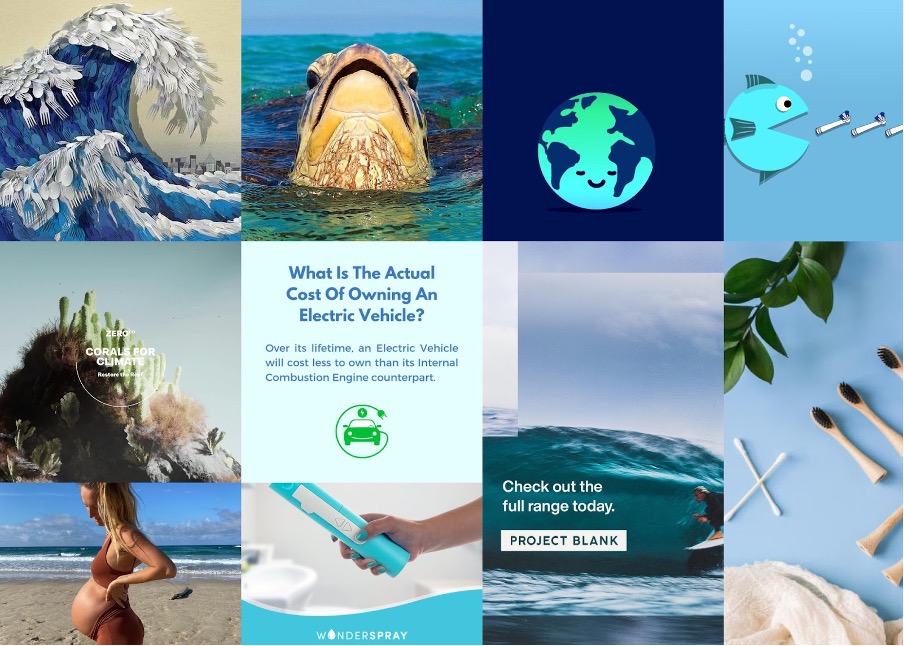
Many claims to be greener that are made in social media advertising are just that: claims only. There is no way to check if they are telling the truth
Fellow researcher Julian Bagnara, of Melbourne Law School, analysed more than 20,000 impressions and 8,000 Facebook ads. He found terms such as ‘clean’ and ‘sustainable’ were frequently used, often with no explanation of what lay behind them. So were emojis such as the Earth, the recycling icon, green ticks and green hearts.
The top five sectors making green claims were energy, household products, fashion, health and personal care, and travel.
“Many Australians want to do the right thing by the environment where they can, and it’s important that they be able to rely on what businesses claim about their green credentials if they are to make free and fair decisions about where their money goes,” Mr Bagnara said.
Professor Parker warned that the widespread use of these terms makes it looks like change is happening when it is not: “This could delay important Government action on tackling climate change as it dilutes the sense of urgency around the issue.”
The report urges that the Federal Government legislate to give power to define and regulate green claims to the ACCC (the Australian Competition and Consumer Commission) and ASIC (Australian Securities and Investment Commission).
“Currently, Australian consumer law does not allow regulators to make rules about the standards of information for goods and services,” she warned.