From education to precision use, AI Centre eyes next five years
Five years ago, artificial intelligence was only starting to move from expert circles into everyday life. Anticipating its growth, the Centre for Artificial Intelligence and Digital Ethics (CAIDE) began in 2020, to ensure that regulation, research and community literacy kept pace with this new technology.
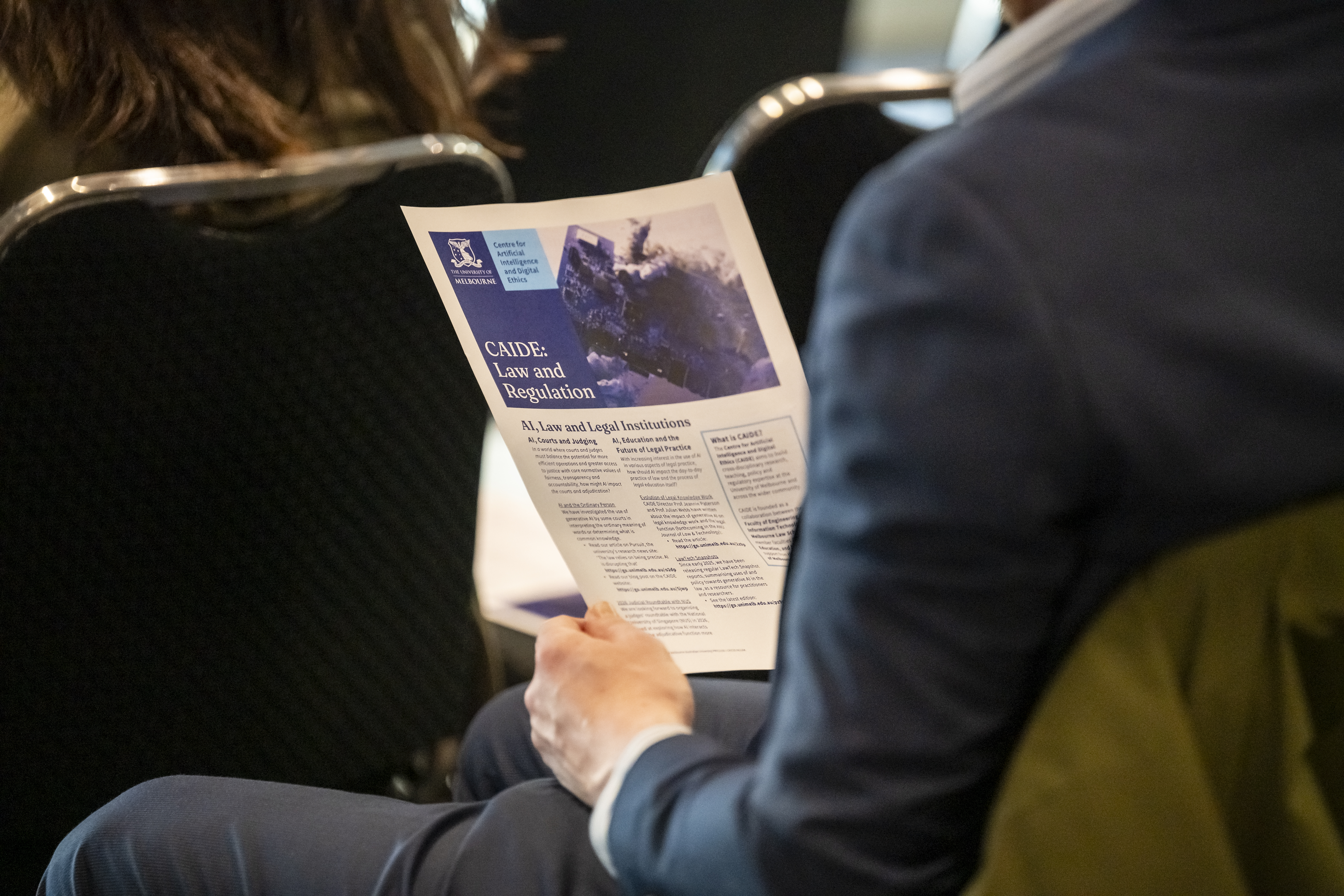
Today, AI is no longer speculative but embedded in courts, classrooms, workplaces and cultural phenomena. From Taylor Swift mania and major event digital-ticketing regulation to judicial reflections on AI in the court room, CAIDE’s work has broad resonance across modern life.
In the early years, CAIDE focused on foundation-building: cross-disciplinary research, public education, and conversations to assist communities understand the emerging technology. Now, renewed funding is carrying the Centre into its next five years.
“We’ve laid the groundwork for public literacy around AI,” says CAIDE director Professor Jeannie Paterson.
“The next phase moves from the general to the precise. Building targeted responses; addressing bad actor uses, such as deep fakes; and supporting constructive, tailored uses of AI in areas like justice, mental health, and education.”
CAIDE, housed in Melbourne Connect, is a cross-disciplinary research, teaching, and policy and regulatory-focussed centre, founded as a collaboration between the Faculty of Engineering and Information Technology and Melbourne Law School, with member faculties Arts, Education, and MDHS, supported by the University of Melbourne.
The Centre’s scope is varied. Early in 2024, Professor Jeannie Paterson gave expert comment on Australian major-event regulation and rising digital-ticket reselling as scalpers leveraged the frenzy during Swift’s Australian tour. This was in the lead up to the University of Melbourne’s Swiftposium, at a time, Swift was the target of high-profile deepfakes attacks.
“The Taylor Swift project wasn’t something we planned, it was an opportunistic moment that really resonated. We’ve always tried to focus on what’s happening right now and use it to help people understand what’s coming next. During lockdown, for example, our work on exam-proctoring technology took off, and more recently we’ve been demonstrating how easy deepfakes are to create. The Swift piece was another way to unpack the complexity of new spaces and emerging issues,” says Professor Paterson.
The Ninian Stephen Law Program: New Thinking for Emerging Technologiesproject, in partnership with the Menzies Leadership Foundation, honed the Centre’s expertise on the challenges and opportunities for legal professions arising from AI. The Program produced a report and a series of policy symposiums that aimed to equip lawyers with the skills, knowledge, and frameworks within our rapidly evolving technological legal landscape.
The program also developed the ‘LawTech Snapshot Reports’ – an annual database of current statements of use and policy, mapping how the legal sector is using and regulating generative AI, spanning domestic and overseas jurisdictions. The resource includes examples of use by law firms, community legal centres and government organisations, as well as policies and other guidance from law societies, courts and regulators.
Highlights of CAIDE’s activities have been the Stephen Ninian Orations, a flagship public lecture series delivered annually within the Ninian Stephen Law Program. In 2024 Joseph Long, Chairman of ASIC, spoke on AI and financial Services regulation. In 2025, Chief Justice Niall SC presented on the risks and large opportunities that AI technologies are imposing on justice and the judicial process.

Chief Justice Niall of the Supreme Court of Victoria, speaking on AI and the law, at the 2025 Ninian Stephen Oration, hosted by CAIDE at Melbourne Law School. Read a transcript of the Chief Justice’s speech, as provided by the Supreme Court of Victoria.
“A big part of our work previously has been demystifying AI, making it understandable and relevant, including for lawyers, courts and access-to-justice settings. You can really see the impact: we’ve contributed to law reform processes, published widely, delivered training and spoken at conferences across various sectors,” Professor Paterson says.
“Chief Justice Niall’s presentation here at Melbourne Law School was an incredibly valuable evaluation. He spoke from experience, and as a judicial leader, on how we can ensure AI supports, but doesn’t replace human judgement within the judicial process. Not restricted to lawyers, that’s an ethos applicable to how all of society can approach integrating these new technologies.”
If the first years asked how society should understand AI, the next five years ask how we shape it, and who benefits? CAIDE’s agenda now stretches from mitigating risks to enabling focused, ethical deployment.
“We are now exploring the more bespoke uses of AI, whether that be responding to the ‘dark side’ of misinformation or scams, understanding the role of chatbots and their interactions with humans or the possibilities new technologies are offering specific industries and how we incorporate them - with good regulation for societal benefit.
“What does AI look like for improving access to justice or supporting overworked mental health professionals? How do courts use technology to enhance, not erode, fairness? How do we protect public trust when generative tools blur truth and fabrication?,” she says.
CAIDE has also moved into new fields, such as through Professor Christine Parker and Dr Simon Coghlan’s work on AI, technology and animals and the Art AI and Digital Ethics initiative.
CAIDE aims to build on its already strong experience in AI literacy, with its well regarded training in ‘Demystifying Ethical AI’ Such targeted initiatives include:
- Building Resilient Legal Advice for Cyber and Critical Technologies’ in Vietnam, as funded by the Department of Foreign Affairs and Trade’s Cyber and Critical Technology Cooperation Program (CCTCP). The project strengthened the capacity of Vietnamese lawyers to provide ethical, rights-based legal advice on emerging technologies.

CAIDE members, in Vietnam, as part of the Building Resilient Legal Advice for Cyber and Critical Technologies’ project.
- Partnering with DFAT’s Australia-India Cyber and Critical Technology Partnership project, Project BUILD, to identify barriers to inclusive design of AI/ML tools in digital healthcare, to develop ethical policy frameworks for the development and deployment of existing and future critical technologies in healthcare.
- CAIDE has also partnered with AVPN, Asia’s leading social-investor network, to deliver bespoke “train the trainer”workshops on AI literacy for not-for-profit organisations across Australia and New Zealand.
Professor Paterson says, in 2026 and beyond, public exploration of AI will continue moving from simply adapting to AI’s presence to designing its (ethical and human-centred) future.