Year in review - 2022
With empathy, humility, humanity, and respect.
Dr Eddie Cubillo, Director, Indigenous Law and Justice Hub.
To all our colleagues and friends
With the formal launch of the Indigenous Law and Justice Hub in 2022, we’ve made some amazing achievements this year, all with a small team who work incredibly hard. I would like to begin this review by sharing my deep appreciation for the Hub staff and all our colleagues and friends who have supported our programs of work in 2022. They have enabled me to share these hopeful stories of our interrelated efforts across teaching and learning, research, and advocacy.

Image: Dr Eddie Cubillo at the launch of the Indigenous Law and Justice Hub
Research
Central to the work of the Hub is community, and the engagement and research projects which binds our community work are starting to take shape. We are prioritising putting in place building blocks towards research outcomes which can make real improvements for Indigenous communities.
Following the finalisation of my PhD research on self-determination in the context of the Aboriginal and Torres Strait Islander Legal Services, we have shared this work and generated discussion on community-control at a number of key forums, including the AIATSIS Summit and through faculty networks.
Through financial support from external funding bodies the Hub has made trips to Nhulunbuy in North-East Arnhem Land. We have begun working with Yolngu organisations to better understand and seek to collaborate in responding to localised justice needs in North-East Arnhem Land. Whilst this project is still in its infancy, community consultation has begun, and the Hub is establishing a project plan for how the Melbourne Law School may provide expertise and advise in a localised way.
We have also begun work on a collaborative research project on Health Justice Partnerships operating through Aboriginal and Torres Strait Islander Community-Controlled organisations, through funding from the Indigenous Knowledges Institute.
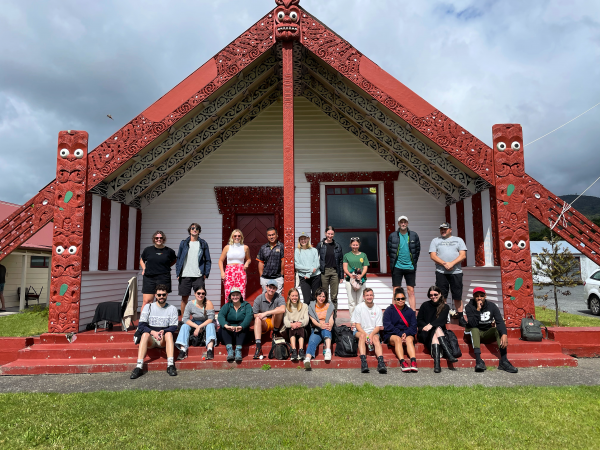 Image: Students taking part in the Indigenous Law in Aotearoa and Australia subject in Aotearoa/New Zealand
Learning and Teaching
An ongoing, significant project in the Hub is the Indigenous curriculum project, where we are working with subject coordinators across the Juris Doctor to shape curriculum which better equips MLS graduates with skills and knowledges to work for Indigenous justice. Through the project, the introductory intensive unit to the Juris Doctor, Legal Method and Reasoning was substantially rewritten to include three full days of Indigenous content across the two-week course – setting a strong initial framing of students’ understandings and expectations of their legal studies and our values as an institution. The project will eventually see Indigenous content included across all ‘Priestley’ compulsory units. Core to this project is exploring ways in which Indigenous voices are centred and included in curricula, particularly with resources from leading First Nations lawyers. You can read more about the curriculum review in the NAIDOC special edition of LIV journal.
Recognising that more opportunities for students to engage deeply with issues of Indigenous justice are needed across the MLS Juris Doctor curriculum, the Hub organised its inaugural travelling elective subject to Aotearoa New Zealand. With financial support from Murrup Barak, Chancellery and Lander & Rogers, Hub staff travelled with 18 Juris Doctor students to Aotearoa New Zealand for two weeks of on country learning about Indigenous law in both jurisdictions. This comparative law subject allowed us to visit key people and institutions in Māori justice and examine shared challenges. Through the two weeks, students attended an international conference on Indigenous constitutionalism, stayed on a marae in Rotorua, heard from Māori firms about litigating on the incorporation of Tikanga Māori (Māori law and custom) into the NZ common law, and meet a Māori justice on NZ’s highest court.
Taking a cohort of Indigenous students to Aotearoa New Zealand aligns ourselves with the University of Melbourne’s Indigenous Internationalisation Plan 2020-2024, as does our visitor scholars program at MLS. For the month of September, we were delighted to host Erin Roxburgh-Makea (Ngāti Porou, Ngāpuhi) from Victoria University Wellington. With her expertise in leadership and governance in Māori organisations, Erin was able to provide us with other perspectives on Indigenous leadership in governance and law, as well as assisting in preparations for the traveling subject.
Going forward, we are excited to be teaching another new traveling subject in collaboration with MLS Clinics on my country – Darwin, lands of the Larrakia people in July, where we will consider the design and delivery of culturally appropriate legal services in Access to Justice on Country.
We have also secured an internal grant to develop a ‘train-the-trainer’ model for Melbourne Law School, to develop data on the training and support that our teaching staff need to confidently teach Indigenous content. This is a significant project which will benefit all Australian law schools.
Advocacy
At the Hub we are privileged to be able to contribute our work to a range of advocacy initiatives supporting First Nations people and organisations, which in turn greatly benefits the quality of our research and teaching.
We are delighted with the stories and community voices that we have been able to share through the White Noise justice talks and podcast, where we have welcomed guests including Apryl Day, Larissa Behrendt, Mick Gooda and Ronnie Gorrie. These regular gathers have become a highlight of our calendar. Many thanks to the MLS Digital Studio. I encourage you to access these recordings.
This year, the Hub played a critical role in the Montgomery High Court litigation concerning issues of Indigenous identity, which was eventually withdrawn following the Hub and other parties petitioning of the Commonwealth government. We supported an intervening party with research briefs and facilitated caucusing of Indigenous parties in the proceedings.
The Hub continues to work closely with the First Peoples Assembly of Victoria on Treaty matters. Throughout 2022, the Hub prepared discussion papers for the Assembly on themes such as ‘Law, Lore and Cultural Authority’, as well as briefing papers and research documents to support the work towards a Treaty Negotiation Framework. We are grateful to the Assembly CEO, Chairs and legal team for teaching into a number of MLS programs, including providing a seminar for MLS teaching staff titled ‘teaching for treaty-readiness.’ I was grateful to have been asked to consider being involved in the recruitment of the Treaty Authority, the ‘umpire’ overseeing the negotiation of Treaties between First Peoples and the State.
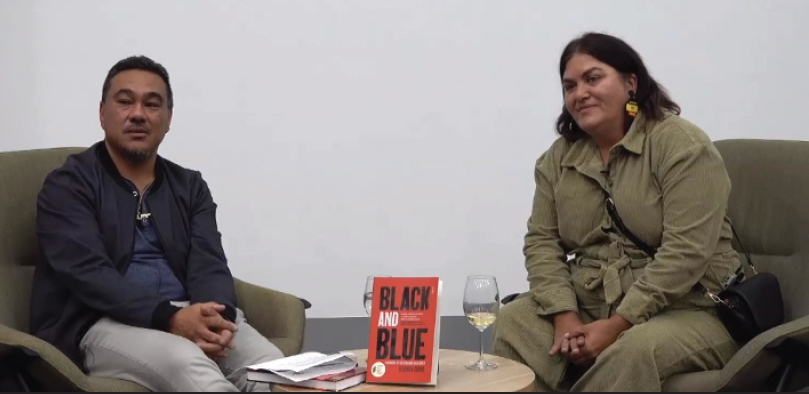
Image: Dr Eddie Cubiilo and Veronica Gorrie in conversation at White Noise event.
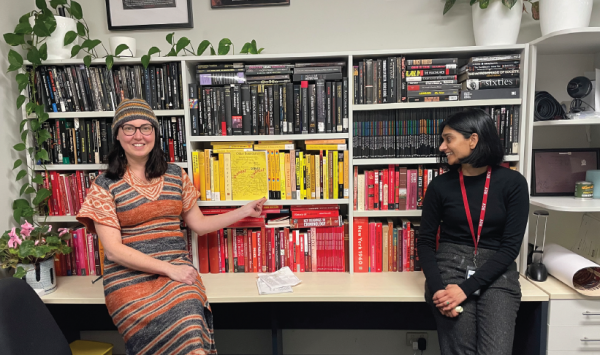
Image: Dr Amanda Porter and Sharmera Kesavan
This year, the Hub has been assisting the North Australian Aboriginal Justice Agency (NAAJA) and the Parumpurru Justice Committee in the Coronial Inquest into the death of Kumanjayi Walker, being held in Alice Springs. Dr Amanda Porter (Senior Fellow, Indigenous Programs) prepared expert reports and will appear before the Coroner’s Court of the Northern Territory in 2023, where she will be giving evidence on policing and systemic racism. Supporting Indigenous advocacy efforts through coronial inquests will be significant part of the Hub’s advocacy going forward. This is especially important given the large discrepancies between the level of representation afforded to state entities such as the police, corrections, health and transport, who are typically represented by the best legal representation money can buy. The Hub is proud to be supporting NAAJA and the Yuendumu community in this significant inquest.
We have contributed to other significant inquiries this year, including giving evidence at
the Yoorrook Justice Commission. Our law reform and research efforts going forward are going to be supported through the research assistance of the students participating in our Law and Advocacy Program. Through the support of Lander & Rogers we have been able to provide opportunities and training for occasional paid employment in the Hub. Eleven students are currently participating in this program, developing their understanding of effective advocacy under the mentorship of our staff.
With thanks to our community
I want to sincerely thank our team and broader community of colleagues for their hard work and commitment to make real change to the way law is taught and practiced on First Nations lands, in recognition of Indigenous peoples and the inequities they face.
We established the Hub’s Advisory Board in 2022 with an incredible group of legal scholars and experts to help guide us as we grow. The Advisory Board’s membership includes Clinton Benjamin, Professor John Borrows, Anton D’Amico, Tim Goodwin, Tony McEvoy SC, Associate Professor Sana Nakata, Professor Pip Nicholson, Elly Patira and Karri Walker. Through the Board’s guidance, counsel and networks, the Hub is able to achieve great things to promote Indigenous justice and I look forward to working with them, our team at the Hub and all our stakeholders in 2023.
 Image: Tim Goodwin presenting via video link at the launch of the Indigenous Law and Justice Hub
The Hub also saw a number of other visitors in 2022 and we invited contributions from this diverse group in various ways. We were inspired to host some incredible guests to the Hub including the Commissioners of the Yoorrook Justice Commission, Mick Gooda (Former Commissioner on the Human Rights Commission), Karen Diver (Native American advocate and former Obama White House Native American Affairs advisor), Debbie Kilroy OAM (CEO of Sisters Inside), Meena Singh (Commissioner for Aboriginal Children and Young People) and Todd Fernando (Victorian Commissioner for LGBTIQ+ Communities).
The intellect and influence these visitors attribute, is something which I value highly and for us to be engaged across these important social justice areas is testament to the growth of the Hub. I hope that in 2023 our Hub community continues to get bigger and more influential in the Indigenous justice space, with our doors always being open for new visitors.
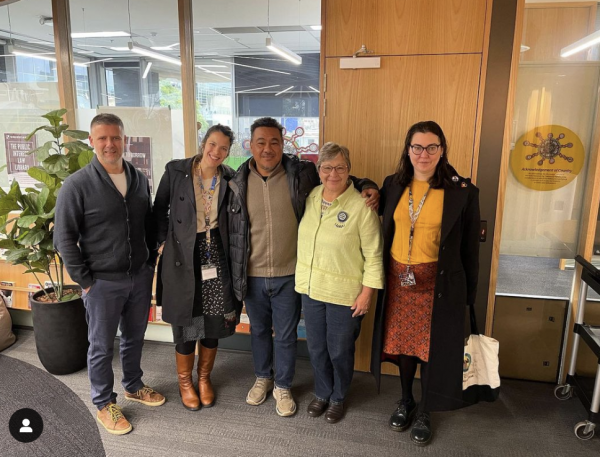
Image: Hub staff with Karen Diver
One of the key areas of work that the Hub continues to focus on is building the cohort of Indigenous law students within the Melbourne Law School. Working closely with Murrup Barak, Melbourne Institute for Indigenous Development, the Hub was actively engaged across the University promoting the JD. Recognising that there is an active student body already at the undergraduate level, the Hub began to build its engagement with the University’s residential colleges and discuss pathways into law for current undergrad students. The Hub has been active working with prospective and current students across all the MLS programs including JD, the Melbourne Law Masters programs and at PhD level. For 2022, the Indigenous student headcount across the Law School was at 35 students, likely the highest it’s ever been.
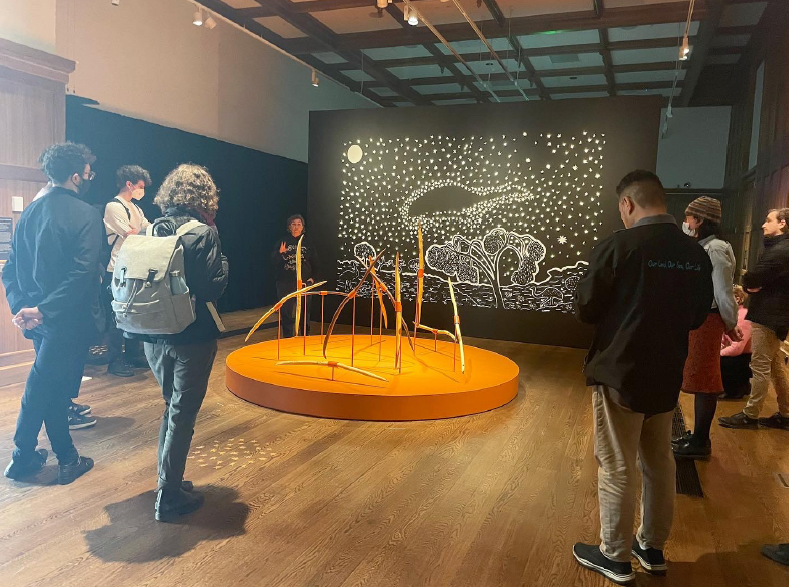
Image: Hub staff and students at Zena Cumpston, Barkandji researcher’s tour of Emu Sky.
It does take a dedicated effort to recruit and support a growing cohort of Indigenous students within the MLS and there have been specific areas of work which allow for this. The Hub has significantly grown its engagement with donors and supporters, and I would like to personally thank all who have contributed to the Hub (financially and in-kind) in 2022. In particular, I thank David Bailey and Mannifera for their generous support.
You can keep up to date with the work of the Indigenous Law and Justice Hub via our Instagram or our email mailing list. I hope everyone has a great break and best wishes.
With empathy, humility, humanity, and respect.
Dr Eddie Cubillo
Director, ILJH.
Download a PDF of the Year in review 2022.
 Image: Dr Eddie Cubillo presenting at AIATSIS Summit 2022