What happens to stateless people in Australia after the High Court ruling?
An overview of the decision of the High Court of Australia in the case NZYQ v Minister for Immigration, Citizenship and Multicultural Affairs (NZYQ) and its impact on stateless people in Australia.
What was this case about, and what was the High Court ruling?
In November 2023 the High Court of Australia ordered the immediate release of the stateless refugee, known as ‘NZYQ’, from immigration detention. NZYQ had previously had his protection visa refused due to a criminal conviction. He was unable to be returned to Myanmar, because he was not recognised as ‘belonging’ to that country (by virtue of his statelessness) and because he had a well-founded fear of persecution in Myanmar. Recognised by the government as a refugee, yet unable to secure an Australian visa and unable to be deported to any other country in the world, NZYQ had spent more than five years in immigration detention and faced the prospect of being detained for the rest of his life.1
The High Court unanimously found that because there was ‘no real prospect’ of his removal from Australia ‘becoming practicable in the reasonably foreseeable future’, his detention was unlawful.2 In other words, because NZYQ was not recognised as ‘belonging’ to Myanmar and no other country would accept him it was not realistic to say that he would be removed from Australia in the near future, making his detention illegal. In making this judgement the High Court overturned the legality of indefinite immigration detention, marking a watershed moment in Australian legal history.
What is immigration detention and how is it different from criminal detention?
Since the early 1990s Australia has had a policy of mandatory detention and mandatory removal of ‘unlawful non-citizens’.3 This means that anyone in Australia without a valid visa – including people who have had their visas cancelled or refused – must be placed in immigration detention and deported from Australia to their country of citizenship or another country that will accept them. If a person whose visa is refused or cancelled is recognised as a refugee, Australia cannot deport them to their country of origin due to a principle called non-refoulement that prohibits their return to a country where there is a risk to their life or where they would face persecution. Refugees without a visa will therefore continue to be held in immigration detention.
Immigration detention is also used to hold some people while their visa applications are being processed and decided upon by the government. Unlike criminal detention (or imprisonment) which is imposed as punishment following conviction of a criminal offence, the purpose of immigration detention is not punishment, but is administrative in nature. For example, immigration detention is used to hold people while decisions are made as to whether they are allowed to enter the country or not, and to make them available for deportation in situations where their visas are cancelled or refused.
Why is this decision important?
The decision in NZYQ is highly significant, overturning almost twenty years of legal precedent established in 2004 in the case of Al-Kateb v Goodwin. 4
To understand the significance of this decision, it is important to first understand the separation of powers in Australia, which is a fundamental principle that supports the democratic process by ensuring that no group or individual has too much power or influence. The separation of powers in Australia is based on the idea that the three different branches of government – the legislature (Parliament), the executive (Ministers) and the judiciary (the courts) – should have independent and distinct powers and responsibilities. Under this principle, the Parliament is responsible for making laws, Ministers (the executive) are responsible for putting law into action and courts are responsible for making judgements on the law – which includes the power to punish and detain (or imprison) people.5
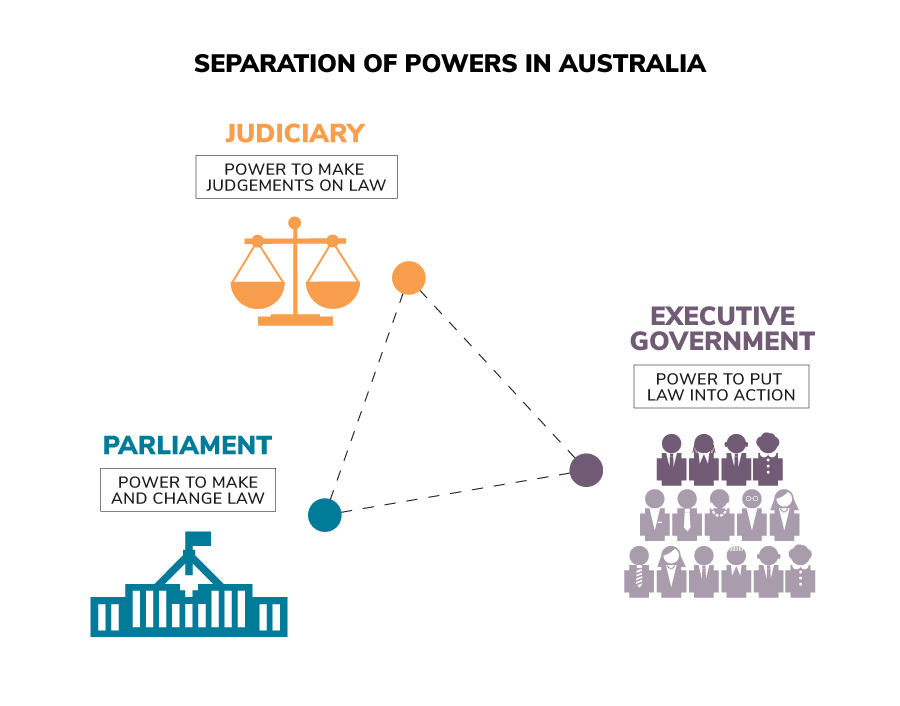
In the case of Al-Kateb, the High Court of Australia found that while normally only the courts have the power to detain people (usually as punishment for a crime), in certain situations Ministers (the executive arm of government) also possess the power to detain, and that immigration detention is one of those situations.6 The Court found that as an exception to the separation of powers rule a Minister could order detention when it was not intended as a punishment. Indefinite immigration detention was seen to fall within this exception as its main purpose was viewed to be ‘administrative’ in nature (i.e. processing visas and preparing somebody for deportation) and not punishment.
In NZYQ the High Court unanimously overruled the decision of Al-Kateb finding that indefinite immigration detention cannot be seen as an exception to the separation of powers principle. The High Court found that there are limits on the powers of Ministers to detain people in immigration detention. That is, indefinite immigration detention or where ‘there is no real prospect of removal… from Australia becoming practicable in the reasonably foreseeable future’7 can no longer be seen as legitimately connected to an immigration purpose (removal from Australia). As such it is punitive and cannot be ordered by anyone other than a court.
The High Court also found that the burden lies with the Government to prove that the reason for the detention of NZYQ – and others in immigration detention – is legitimate and that it does not breach the limitations of the separation of powers principle.8
Does this mean that the government can no longer detain anyone in immigration detention?
No. The decision of the High Court only impacts the ability of the government to detain people indefinitely – that is for an unspecified or unlimited period – not their powers to detain people in immigration detention broadly. The government can still hold people in immigration detention for temporary periods of time when the detention is legitimately connected to the specific purposes of processing their visas or preparing for their removal from Australia.
Why is this decision important for stateless people?
Stateless people do not have a nationality of any country. Legally speaking, they are not recognised as ‘belonging’ to any country in the world.
For two decades, stateless people have faced the prospect of spending lengthy and potentially indefinite periods deprived of their liberty in immigration detention due to Australia’s policy of mandatory immigration detention.
Because stateless people do not have citizenship and are not considered as ‘belonging’ anywhere, there is no country that they can be returned to if their visas are cancelled or refused. Australia also does not provide a specific visa for stateless people. Stateless persons seeking protection in Australia are currently processed for a Protection Visa under the refugee or complementary protection regimes through Australia’s refugee status determination (RSD) procedure. However, not all stateless people meet the definition of a refugee and statelessness is not an ‘independent ground for being granted’ a Protection Visa.
The combination of these factors increases the risk that stateless people will be first placed in immigration detention, and second, that immigration detention is likely to be prolonged or (until the decision in NZYQ) indefinite.
Who is stateless in Australia and who does this decision impact?
Australia has a long and proud history of welcoming stateless people to the country. After World War II Australia welcomed many migrants and refugees, predominantly from Europe, who were deprived of their nationality during or after the war. Many stateless people, including children and families continue to seek and be granted protection in Australia.
This case has highlighted the particular predicament of stateless people who have had their visas cancelled (or their application rejected) and face mandatory immigration detention. However, it is important to understand that Australia’s stateless population is diverse, and includes many individuals, including children and families, that are living in the community and making a valuable contribution to the fabric of our society.
What does this mean for stateless people in Australia in the future?
As stated by the High Court, ‘[r]elease from unlawful detention is not to be equated with a grant of right to remain in Australia.’9 In other words, being released from immigration detention does not mean you have a right to a visa in Australia. Australia does not have a distinct visa category for stateless people or a clear pathway to permanent residency. This means that some stateless people in Australia remain in a form of limbo – unable to live in Australia long term, and unable to be ‘returned’ to another country.
The High Court’s decision is a critical first step in protecting stateless people from being indefinitely deprived of their liberty. However, with no ‘stateless’ visa category or pathway to permanency, stateless people will continue to face a life of uncertainty in the Australian community.
More reading
-
An Overview of Statelessness
What does it mean to be stateless? What is nationality? What are the impacts of statelessness and how many people are stateless worldwide? We answer these questions and more.
-
Statelessness in Australia
How many stateless people are in Australia? How does Australia identify and process stateless persons? An overview of statelessness in the Australian context.
-
A Place to Call Home – Child Statelessness in Australia
This project examines the legal and administrative barriers stateless children in Australia face in obtaining Australian citizenship.
1 Paul Karp, ‘Australia Releases Stateless Man “On Conditions” After Indefinite Immigration Detention Rules Unlawful’, The Guardian (9 November 2023).
2NZYQ v Minister for Immigration, Citizenship and Multicultural Affairs [2023] HCA 37.
3 See Migration Reform Act 1992 (Cth) as amended by the Migration Laws Amendment Act 1993 (Cth). See also the Migration Legislation Amendment Act 1994 (Cth).
4 Al-Kateb v Godwin (2004) 219 CLR 562.
5 For more on the separation of powers see Parliamentary Education Office, ‘Factsheet: Separation of Powers: Parliament, Executive and Judiciary’.
6 See Chu Kheng Lim v Minister for Immigration, Local Government and Ethnic Affairs (1992) 176 CLR 1.
7 NZYQ v Minister for Immigration, Citizenship and Multicultural Affairs [2023] HCA 37, [55].
8 NZYQ v Minister for Immigration, Citizenship and Multicultural Affairs [2023] HCA 37, [59]-[60].
9 NZYQ v Minister for Immigration, Citizenship and Multicultural Affairs [2023] HCA 37, [72].