Submissions and Briefing Notes
Submissions
- Submission to the Legal and Constitutional Affairs References Committee on the Inquiry into Offshore Processing and Resettlement Arrangements. February 2026
- Response to Australian Law Review Commission Discussion Paper on the Review of Surrogacy Laws. December 2025
- Joint Submission to the UN Human Rights Council for Australia's Universal Periodic Review. Submission with Nationality for All and endorsement by RACS. July 2025
- Review of Surrogacy Laws. Response to invitation to make a submission to the Australian Law Reform Commission. July 2025
- Call for submissions on the draft of general comment No. 27 on children’s right to access to justice and to an effective remedy. Submission to the UN Committee of the Rights of the Child. June 2025
- Inquiry into the Australia-Tuvalu Falepili Union Treaty. Submission to the Joint Standing Committee on Treaties. April 2024
- Inquiry into the Migration Amendment (Removal and Other Measures) Bill 2024. Submission to the Senate Legal and Constitutional Affair Legislation Committee. April 2024
- Review of the amendments made by the Australian Citizenship Amendment (Citizenship Repudiation) Bill 2023. Submission to the Parliamentary Joint Committee on Intelligence and Security. February 2024
- Australia should adopt a Human Rights Act to protect the rights of stateless people, including children. Submission to the Parliamentary Joint Committee on Human Rights - Inquiry into Australia's Human Rights Framework. June 2023
- Submission to the Office of the High Commissioner for Human Rights in response to its call for input regarding the Thematic Report for the 78th session of the UN General Assembly, October 2023 - Nexus between Violence against Women and Girls, Nationality Laws, and Statelessness - of the UN Special Rapporteur on Violence Against Women and Girls. May 2023
- Submission to the Office of the High Commissioner for Human Rights in response to its call for inputs regarding the UN Secretary-General's report on the Human Rights of Migrants. May 2023
- Children, Climate Mobility and Statelessness. Submission in partnership with the Kaldor Centre and UTS to the UN Committee on the Rights of the Child. March 2023
- Joint submission to the UN Human Rights Council for Australia’s Universal Periodic Review with partners ISI; RACS and SNAP. July 2020
- Response to World Bank ID4D call for consultation on Principles on Identification for Sustainable Development. March 2020
- Submission to the Legal and Constitutional Affairs References Committee in relation to its Inquiry into Nationhood, national identity and democracy November 2019
- Submission to the Parliamentary Joint Committee on Intelligence and Security in relation to its Review of the Australian Citizenship Amendment (Citizenship Cessation) Bill 2019. October 2019
- Submission to the Senate Legal and Constitutional Affairs Committee in relation to the Migration Amendment (Repairing Medical Transfers) Bill 2019. August 2019
- Submission to the Senate Legal and Constitutional Affairs Committee in relation to the Migration Legislation Amendment (Regional Processing Cohort) Bill 2019 [Provisions]. August 2019
- Submission to the Parliamentary Joint Committee on Intelligence and Security in relation to its Review of the Australian Citizenship renunciation by conduct and cessation provisions.
- Submission to the Legal and Constitutional Affairs Legislation Committee in relation to the Migration Amendment (Strengthening the Character Test) Bill 2019. August 2019
- Submission to the Parliamentary Joint Committee on Intelligence and Security in relation to the Counter-Terrorism (Temporary Exclusion Orders Bill). March 2019
- Submission to the Parliamentary Joint Committee on Intelligence and Security as contribution to its Advisory Report on the Australian Citizenship Amendment. January 2019
- Submission to the Special Rapporteur on Minority Issues regarding Statelessness and legal identity issues among ethnic Vietnamese minority populations in Cambodia, in partnership with Minority Rights Organization (MIRO), Cambodia, May 2018
Briefing Notes
Rohingya citizenship status in post-coup Myanmar
Published 8 May 2026
The Rohingya are often referred to as the world’s largest stateless population. It is well documented that Rohingya have faced significant human rights abuses and protracted displacement over recent decades whilst also having no rights to Myanmar citizenship. Nearly 80% of Rohingya, estimated to total 2.8 million worldwide, now live outside Myanmar.
There has been scant research focused on the context for Rohingya since the 2021 coup in Myanmar. To help fill this gap, these two briefing notes look both backwards and forwards in an effort to understand the struggles, current political dynamics, and possibilities for Rohingya, and their citizenship, in a future Myanmar.
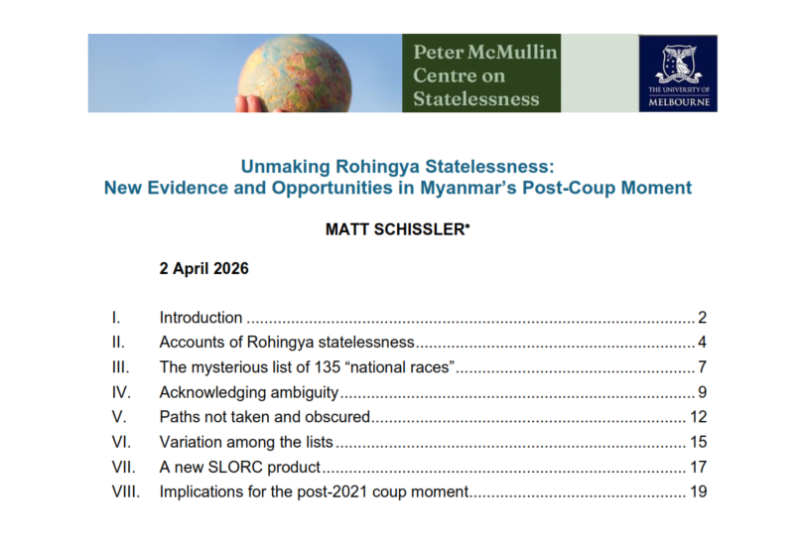
The paper "Unmaking Rohingya Statelessness" by Dr Matt Schissler takes up the question of how the Rohingya have been made stateless, and particularly how this has hinged on the way citizenship by birth is available only to those who the state recognises as one of Myanmar’s “national races” (taing yin thar).
Briefing note: "Unmaking Rohingya Statelessness"
The second paper "Rakhine's Changing Political Order and the Future of Rohingya Citizenship" by Sophia Htwe examines the evolving political landscape in Myanmar's Rakhine State following the 2021 military coup and the consolidation of de facto authority by the Arakan Army (AA). A version of this briefing paper with policy recommendations has also been published by ANU as a Policy Brief presented to DFAT on 8 May 2026.
Briefing note: "Rakhine's Changing Political Order and the Future of Rohingya Citizenship"
These briefing papers were made possible with the support of the Myanmar Research Network at the University of Melbourne and the Myanmar Research Centre at the Australian National University.
Malaysia's proposed amendments to citizenship provisions in its Federal Constitution
Published 17 October 2023
If passed into law, most of the recent amendments proposed by the Malaysian Government to citizenship provisions in Malaysia’s Federal Constitution will have a deleterious impact in terms of reducing the number of cases of statelessness in the country and from preventing new cases from arising. On the contrary, statelessness (particularly cases of statelessness amongst children and intergenerational statelessness) is likely to increase. Childhood statelessness can significantly stunt a child’s development: lack of citizenship typically means that children cannot access basic services, including education and healthcare, increases their exposure to harmful and exploitative practices such as trafficking or indefinite detention, and severely curtails their future employment prospects and prosperity.
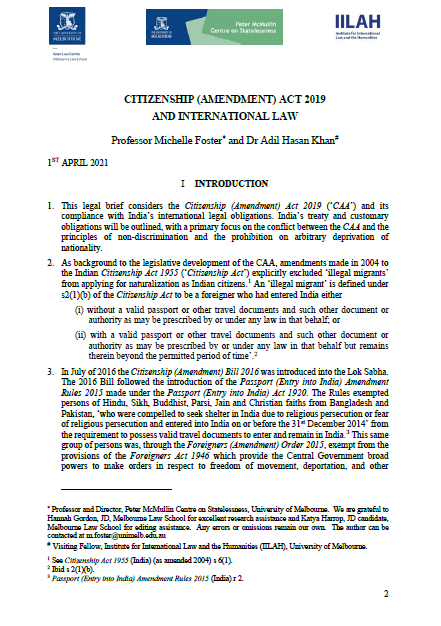
Citizenship (Amendment) Act 2019 and International Law
Published 1 April 2021
A Legal Brief prepared by the Peter McMullin Centre on Statelessness, the Asian Law Centre, and the Institute for International Law and the Humanities.
This legal brief considers the Citizenship (Amendment) Act 2019 (‘CAA’) and its compliance with India’s international legal obligations. India’s treaty and customary obligations are outlined, with a primary focus on the conflict between the CAA and the principles of non-discrimination and the prohibition on arbitrary deprivation of nationality.
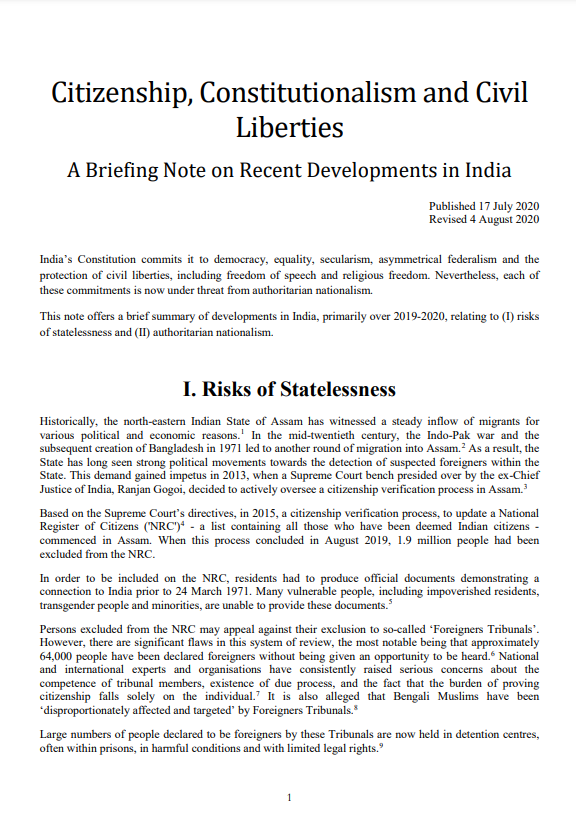
Citizenship, Constitutionalism and Civil Liberties - A Briefing Note on Recent Developments in India
Published 17 July 2020
Revised 4 August 2020
Indian Citizenship and Statelessness Research Project Briefing Note prepared by the Peter McMullin Centre on Statelessness and the Asian Law Centre.
India’s Constitution commits it to democracy, equality, secularism, asymmetrical federalism and the protection of civil liberties, including freedom of speech and religious freedom. Nevertheless, each of these commitments is now under threat from authoritarian nationalism.
This note offers a brief summary of developments in India, primarily over 2019-2020, relating to (I) risks of statelessness and (II) authoritarian nationalism.